
Kanban Methodology: How it works, advantages and disadvantages
Advertisements
The Kanban Methodology It is an excellent strategy for companies that want to optimize processes and increase efficiency.
But, if you are not yet familiar with this idea, don't worry, because in today's content we will look at all the secrets of this approach.
So, if you want to improve your business processes, read on for an effective strategy!

Core concepts:
- Understand the principles and operation of the Kanban methodology.
- Discover the main advantages of implementing this approach
- Find out how this can be applied in different areas, from software development to project management.
- Identify challenges and tips to successfully implement this strategy in your organization.
- Get inspired by examples of companies that achieved significant results by adopting Kanban
Are you ready to discover how the Kanban methodology can change the way your team works? Let's go!
What is Kanban methodology?
Advertisements
The Kanban methodology arises from toyota production system, called the Toyota Production System (TPS), and has basic principles such as see the workflow, limit work in progress and always improve.
So, with the Kanban tool, teams clearly see tasks, their status, and their progress, which helps them manage work better.
Origin and basic principles
Kanban began in Japan in the 1940s, when the Toyota brand began to prioritize improvement efficiency of its production.
That said, the basic principles of the Kanban methodology are:
- Workflow view
- Work in progress (WIP) limitation
- Continuous improvement
Visual Workflow
The Kanban workflow is shown visually, with frames and cards, which helps the team understand tasks, their status and progress, and makes it easier to manage work.
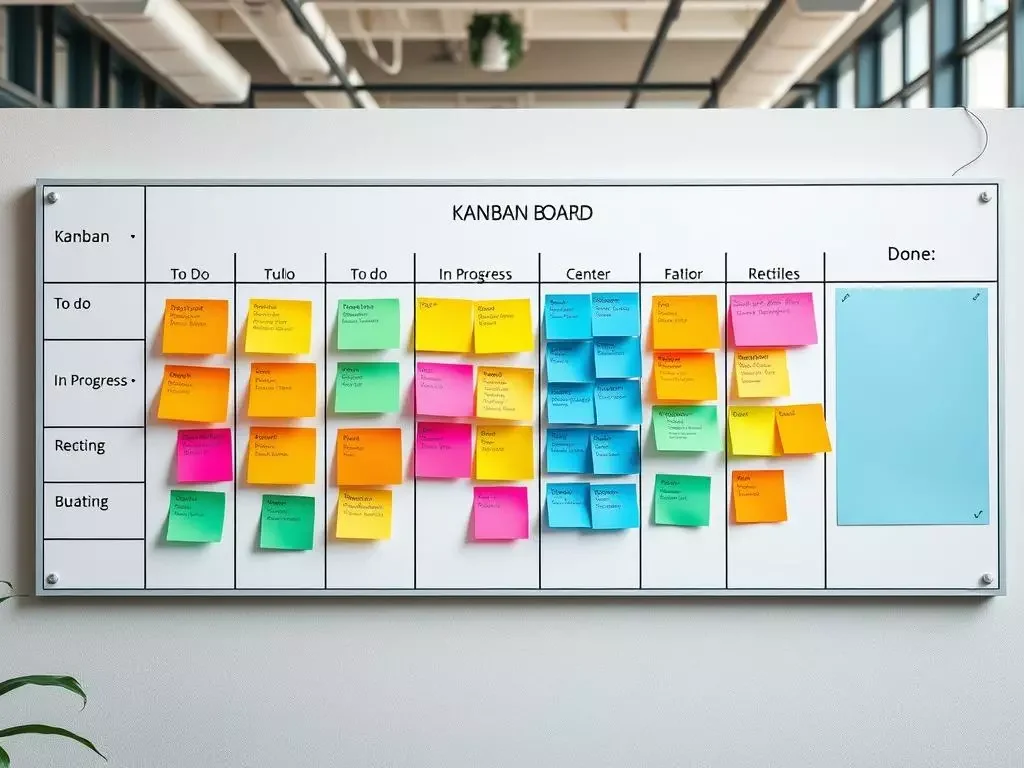
So, your use of this Kanban methodology increases the productivity and others transparency, as the method provides an overview of what is being done.
How does the Kanban methodology work?
The Kanban methodology uses a visual system to monitor the workflow, in which tasks are displayed using cards on a Kanban board, made up of columns that symbolize the stages of the process.
This way, as tasks move between columns, it allows the team to see progress and find stuck points.
In this way, it is possible to focus on the most important tasks and, by prioritizing them, the delivery of results becomes faster.
The Kanban workflow follows specific steps:
- Booking: Tasks are prioritized and posted on the board.
- In progress: This is where tasks are carried out.
- Revision: Tasks are reviewed before completion.
- Finished: At this stage the completed tasks are stored.
This clear visualization of the workflow helps the team find bottlenecks, as well as facilitate task balancing and decision making to increase productivity.
“The Kanban methodology provides a simple and effective way to manage work, keeping the entire team aligned and focused on the most important objectives.” – Process Analyst
Finally, using the Kanban board and tracking the workflow makes the development process more transparent and efficient.
++How the Pomodoro technique can increase your daily productivity – iMedias.
Benefits of the Kanban methodology
The Kanban methodology brings many benefits to teams and organizations, thanks to the increase in productivity, which occurs because the team begins to monitor the workflow and identify deviations, allowing them to focus on the most important tasks.
Additionally, as it is a method that prioritizes transparency, everyone can see the progress of the work, which improves communication and collaboration, helps coordinate efforts, and reduces the time spent on meetings and updates.
Increased productivity
Kanban increases team productivity in several ways:
- Eliminate deviations and show where work is stuck.
- Define which tasks are most important and urgent.
- Avoid working on several things at the same time
- Greater visibility of what is being done and progress
Transparency in the process
The Kanban board makes work more transparent, allowing you to:
- Let everyone see what is being done.
- Managers track progress better
- Tasks and responsibilities are clear.
- Identify and resolve problems quickly
So, this visibility improves communication and collaboration, resulting in more efficient work and increased productivity.
Kanban Methodology: Practical Applications
The Kanban methodology is widely used in various areas, such as software development and project management.
This is because, by helping to monitor all stages of the project, it becomes an effective tool for professionals from different niches.
Kanban in software development
In software development, Kanban helps teams have a clear vision of what is being done.
This makes it easier to find and resolve issues that may delay delivery.
So with this strategy, teams can work better and deliver quality software faster.
Kanban in project management
In project management, Kanban provides a visual and collaborative way to monitor progress, allowing you to prioritize and make decisions, keeping teams focused on project goals.
| Applications of the Kanban methodology | Benefits |
| software development | Workflow visibilityIncreased productivityFast software delivery |
| Project management | Visual and collaborative approach.Effective task prioritizationImproved decision making |
Popular Kanban Tools
The Kanban methodology has become very popular in recent years, which has led to the emergence of several digital tools to assist in its implementation.
Some of the most used Kanban tools are Trello, Jira and Asana.
These apps offer customizable dashboards, work limits, automations, and integrations with other programs.
Trelo
Trello is well known and used around the world and allows you to create custom Kanban boards.
These boards have lists and cards to represent the steps in the workflow.
Additionally, this app has collaboration features, notifications, and integration with other tools.
Yeah
Jira is widely used, especially by software development teams.
This is because it offers Kanban boards and advanced features for task tracking, planning, and reporting.
asanas
Asana is another popular option that allows you to create Kanban boards and visualize your workflow.
It also has integrations with various applications, such as Gmail and Slack.
These are just a few of the most popular kanban tools, so when choosing an option, consider the needs of your team and project, and think about ease of use and available features.
| Tool | Key Features | Integration with other tools |
| Trelo | Kanban boards, work boundaries, collaboration. | Google Drive, Dropbox, Slack, GitHub |
| Yeah | Project management, task tracking, reporting. | Confluence, Bitbucket, Slack, Zoom |
| asanas | Kanban boards, collaboration, automations. | Gmail, Slack, Microsoft 365, Adobe Creative Cloud |
Integrating Kanban with other methodologies
The Kanban methodology can be used in conjunction with others, such as Scrum, and this creates a strong synergy between them.
This union, called Scrumban, brings benefits to both, making teams more flexible and adaptable.
Kanban and Scrum: an effective combination
Kanban focuses on showing the flow of work and managing WIP, so it fits well with Scrum, which has specific events and roles.
This helps teams gain clear insight into the process and improve value delivery.
With Scrumban, teams win:
- Greater transparency and visibility of the workflow
- Better workflow management and WIP limits
- Agile adaptation to changes and priorities
- Continuous delivery of value to customers.
So, integrating this strategy with other methodologies makes teams more effective, as it allows them to choose the best of each approach and adapt it to their needs.
“The Scrumban approach combines the structure of Scrum with the flexibility and visibility of Kanban, creating a powerful solution for agile teams.”
Disadvantages of the Kanban methodology
The Kanban methodology brings many benefits to companies, but it is important to know the disadvantages and challenges it can bring.
A big challenge is training and adapting the team; after all, changing habits and mindsets can take time and some employees may resist change, which can be a problem.
Another point is to set correct work in progress (WIP) limits, since without clear limits, there may be too many tasks in progress, which can disrupt the workflow.
- Need for training and adaptation of the team.
- Resistance to change on the part of employees.
- Difficulty setting work in progress (WIP) limits
So, the Kanban methodology may not be ideal for complex projects or with tight deadlinesIn these cases, Scrum may be better.
| Disadvantage | Description |
| Resistance to change | The team may have difficulty adjusting to the new way of working, which will require additional training and awareness efforts. |
| Inadequate WIP limits | Setting work in progress (WIP) limits can be challenging and impact process flow. |
| Complex or short-term projects | The Kanban methodology may not be the best choice for projects with very complex requirements or tight deadlines. |
Tips for successfully implementing Kanban
To successfully implement Kanban, it is important to focus on two points: team training and continuous adaptation.
Team training
Before using Kanban, it is essential to train the entire team, as this helps employees understand the principles and practices.
That said, Kanban team training should cover:
- Kanban basics, such as visual workflow and work-in-progress limits.
- Flow management techniques, such as prioritizing tasks and identifying bottlenecks.
- Continuous improvement practices, such as holding retrospective meetings.
Continuous adaptation
After implementing Kanban, it is important to maintain an attitude of continuous adaptation.
In this case, the team should adjust the Kanban board and boundaries as needs change, as this keeps the strategy effective.
Continuous adaptation involves:
- Constant monitoring of workflow and identification of areas for improvement
- Hold regular meetings to discuss and implement adjustments to the Kanban board.
- Effective communication across the team to ensure everyone is aligned with the changes.
With team training and continuous adaptation, you will be on the path to a successful Kanban implementation in your company.
Success stories with Kanban
The Kanban methodology is widely used in various companies. It proves its effectiveness in various sectors. Examples of success with Kanban include:
- Or Spotify, a music platform, uses Kanban to improve software development, which has increased agility and delivery of value to customers.
- TO Tesla uses Kanban in production and thus optimizes work and improves overall efficiency.
These companies that have successfully adopted Kanban demonstrate how versatile it is, as they have improved productivity, transparency, and responsiveness to customer needs.
“Kanban has allowed us to offer new features that are much more agile and efficient to our users.”
Other examples of success with Kanban come from various industries, where by applying technology to manufacturing, these companies have improved their processes, and have also increased productivity and customer satisfaction.
Conclusion
In this content we were able to learn about the Kanban Methodology, an agile and effective way of managing projects and processes.
As we have seen, this strategy relies on a visual system to show the flow of tasks, allowing teams to see where they are stuck and create strategies to improve productivity.
So now that you understand the concept and the methods of application, consider including it in your business.
This is because organization and process optimization are the real secrets to completing projects.
This might interest you: Personal development: books that transform your mindset – iMedias.
